














































ANSI Z87.1 · Safety Guide
ANSI Z87.1 Safety Glasses: Ratings & Markings Explained
ANSI Z87.1 proves a pair was tested to stop impact, dust, splash, and radiation, not just built to look the part. This guide decodes the marks, sorts Z87 from Z87+, and points you to the right rating for your hazard.
Shop ANSI-rated safety glasses →ANSI Z87.1 is the U.S. standard that proves a pair of glasses was tested to stop impact, dust, splash, and radiation, not just built to look the part. If you don’t see a Z87 mark, it is not an OSHA-compliant pair of safety glasses, no matter how rugged the frame looks. This guide explains every marking stamped on a compliant pair of safety glasses, the difference between Z87 and Z87+, and points you to the right rating for the specific hazards in your work environment. Do you have a prescription? Read this first, then jump to our guide to ANSI prescription safety glasses.
What is ANSI Z87.1?
ANSI/ISEA Z87.1 is the American National Standards Institute’s standard for occupational eye and face protection, developed in conjunction with the International Safety Equipment Association (ISEA). It sets the lab tests eyewear has to pass: high-mass and high-velocity impact, lens retention, optical clarity, and separate exposure tests for dust, splash, and radiation. The current edition is ANSI/ISEA Z87.1-2025, published in January 2026; it replaced the 2020 edition. A pair that passes carries the Z87 mark, and OSHA uses this standard as its benchmark for workplace eye protection (note: OSHA’s regulation currently incorporates earlier editions, Z87.1-2010 and prior, even though 2025 is the latest).
Z87 vs. Z87+: the mark that matters most
Z87 means the eyewear passed the basic impact test. Z87+ means it also passed the high-velocity test, where a quarter-inch steel ball is fired at the lens. Any work that throws particles, such as grinding, machining, masonry, woodworking, or hammering, calls for Z87+. The “+” is the first thing to look for on a jobsite. SafetyGearPro lists the exact rating on every product page, and most of the frames we carry are Z87+ rated.
The quick rule
If the work throws anything, whether it is sparks, chips, dust, or fragments of any kind, you need Z87+. Plain Z87 is basic impact only. Look for the “+” stamped right after the Z87 on the frame and lens.
Reading the markings on your safety glasses
Every compliant pair is stamped with letters and numbers on the frame and lens, and each one tells you a specific test it passed. Here’s the key:
| Marking | What it means |
|---|---|
| Manufacturer mark | The maker’s logo or initials, which are required; says who stands behind the rating |
| Z87 | Meets basic-impact ANSI Z87.1 |
| Z87+ | Meets high-velocity / high-impact |
| D3 | Splash and droplet protection (liquids, chemicals) |
| D4 | Dust protection |
| D5 | Fine-dust protection |
| W + shade # | Welding filter, with shade number |
| U + scale # | UV filter scale |
| R + scale # | Infrared filter scale |
| L + scale # | Visible-light filter scale |
| V | Photochromic (auto-darkening) lens |
| S | Special-tint lens |
| H | Built for smaller head sizes |
| X | Anti-fog (optional marking, for lenses that pass the anti-fog test) |
A lens marked Z87+ D3, for example, passed high-velocity impact and the splash test, the combination you want for pressure-washing or chemical work. Our clear safety glasses and anti-fog safety glasses pages list these markings per product.
How to tell if safety glasses are genuinely ANSI-rated
On a real ANSI-rated pair, both the manufacturer mark and the Z87 (or Z87+) mark appear on the frame and the lens. If either is missing, the eyewear is not certified. Check the temple arm for the maker’s mark followed by Z87/Z87+, then check the lens for a matching mark. A “Z87 look-alike” sold with no manufacturer mark has never been verified to meet the standard, no matter how tough it feels in the hand. SafetyGearPro states the certification each product carries right on its page, so you can confirm the rating before you buy. If it isn’t marked, it is not safety-rated.
ANSI vs. MIL-PRF (ballistic): when Z87+ isn’t enough
Z87+ is the workplace high-impact standard; MIL-PRF-32432 is the military ballistic standard, which fires a heavier projectile at higher velocity. They aren’t substitutes for each other. A Z87+ lens handles jobsite debris but isn’t certified ballistic, and a ballistic lens (Wiley X, Oakley SI) usually meets Z87+ in addition to MIL-PRF. If you shoot, ride, or work around fragmentation, look for the MIL-PRF mark alongside Z87+.
Does OSHA require ANSI-rated safety glasses? And who pays?
OSHA requires employers to provide eye protection meeting ANSI Z87.1 wherever there’s a real risk of eye injury (29 CFR 1910.133), and a separate rule (29 CFR 1910.132(h)) requires the employer to pay for most required PPE, including safety eyewear. The exception is non-specialty prescription safety eyewear that the employer lets workers take home (refer to 29 CFR section 1910.132(h)(2). Reimbursement requirements vary in that scenario, so check your company’s safety program. For teams, SafetyGearPro has a corporate safety program with bulk discounts and convenient Net-30 billing.
Lens materials, compared
Polycarbonate is the default safety lens because it’s impact-resistant by nature and blocks essentially all UV; Trivex matches polycarbonate’s impact protection, but is lighter and provides better clarity; high-index is for strong prescriptions, not for impact. For most jobs:
- Polycarbonate — the standard for Z87+: tough, light, and it blocks essentially all UV on its own. The right call for most work. (Inherent UV-blocking isn’t the same as a rated U filter — that takes the U mark.)
- Trivex — comparable impact, a touch crisper optically, very light. A premium pick.
- High-index (1.67 / 1.74) — thins down a strong prescription; chosen for the prescription, not the impact rating (the prescription guide covers how this works in safety lenses).
- Glass — rarely the right call for safety eyewear: heavy, and it can shatter.
For more information about prescription lens choices, see the ANSI prescription safety glasses guide.
Lens coatings, compared
Coatings are a separate choice from the lens material, and the right ones depend on your environment. A coating can be the difference between glasses you keep on and glasses you push up onto your forehead. The common ones:
- Anti-fog — the one most workers wish they had. It keeps lenses clear when you move between temperatures, sweat, or wear a mask or respirator. Worth adding if you fog up regularly; see our anti-fog safety glasses.
- Anti-scratch (hardcoat) — a hardened surface that resists everyday scuffs. It does not make a lens scratch-proof, but it adds real life on a dusty jobsite.
- Anti-reflective (AR) — cuts reflections off the front and back of the lens; easier on the eyes for screen work and night driving.
- UV — blocks UVA and UVB. Polycarbonate blocks essentially all UV on its own, so this matters most on other materials or tinted outdoor lenses.
- Mirror and tint — cut brightness and glare for outdoor work; gray keeps colors true, brown lifts contrast.
- Photochromic — darkens in sunlight and clears indoors (the V mark), so one pair covers in-and-out work.
- Polarized — kills glare off water, snow, and flat surfaces; the best choice for driving and waterside work, in a Z87+ frame.
- Blue-light filter — filters some of the blue light from screens, for shop or office work in front of a monitor.
Most coatings can be combined; anti-fog plus anti-scratch is the workhorse pairing for the trades.
Features that decide whether you’ll wear them
Past the rating, fit and coverage are what decide whether a pair stays on your face all shift. Look for a wrap or close-fit frame that blocks particles from the side, or one with built-in side shields. A frame that pinches or slips ends up on your forehead, and glasses that are off protect nothing, so size it to your face. For dusty or over-the-glasses needs, we carry foam-padded and fit-over styles. For coatings such as anti-fog and tint, see the lens coatings section above.
Choosing by job and hazard
Match the mark to the hazard: impact takes Z87+, chemical or splash adds D3, heavy dust adds D4/D5, welding takes the W/U/R/L filter marks, and bright outdoor work takes a tint or polarized lens that’s still Z87+. A quick guide:
Grinding, machining, construction
Z87+ polycarbonate, wrap or side-shielded.
Chemical handling, healthcare
Z87+ with D3 splash rating; a sealed or goggle style if exposure is heavy.
Heavy dust (concrete, demo)
Z87+ with D4/D5, foam-padded or sealed.
Welding and torch work
The correct W + shade — see welding safety glasses.
Outdoor and road crews
Z87+ tinted or photochromic — see ANSI-rated safety sunglasses.
Working a specific trade? Each guide below goes deep on the hazards, the ratings that match them, and the frames that hold up on the job:
- Construction — impact, dust and jobsite Z87+.
- Manufacturing — machining, grinding and plant-floor Rx.
- Healthcare — splash, bloodborne pathogens and clinical Rx.
- Oil & gas — H2S, offshore glare and cold-weather fog.
- Mining — MSHA, underground fog and surface glare.
- Laboratory — chemical splash, D3 goggles and cleanrooms.
- Food processing — washdown, sanitizers and cold-room fog.
- Agriculture — UV, dust/chaff and EPA pesticide rules.
- Electrical — non-conductive frames and NFPA 70E arc flash.
- Automotive — brake dust, battery acid and grinding sparks.
- Welding — filter shades and Rx under the helmet.
- Tactical & shooting — ballistic platforms and Z87+ Rx inserts.
Caring for your safety glasses
Rinse the grit off before you wipe the lenses, clean them with a microfiber cloth and lens spray, store them in a case, and replace lenses once they’re badly scratched. A deep scratch can fail at the point of impact, and it interferes with your vision. Skip the shirttail and paper towels; they grind grit across the lens. Keep them off a hot dashboard, since heat warps frames and degrades coatings, and keep solvents and window cleaner away from coated lenses. A polycarbonate safety lens holds its rating for years with that basic care. Replace it the moment you see a crack, pitting, or a damaged frame.
Frequently asked questions
What does Z87 mean on safety glasses?
It means the eyewear meets ANSI/ISEA Z87.1 for basic-impact protection. Z87+ means it also passed the tougher high-velocity impact test.
Are all safety glasses ANSI rated?
No. Only eyewear that passed Z87.1 testing and carries the Z87 or Z87+ mark is ANSI rated. Look for the manufacturer mark plus Z87 on both the frame and the lens.
Do safety glasses have to be ANSI rated for work?
In most U.S. workplaces, yes. OSHA requires eye protection meeting ANSI Z87.1 wherever there’s an eye-injury hazard, and generally requires the employer to provide it.
What’s the difference between Z87 and Z87+?
Z87 passes basic impact; Z87+ passes the high-velocity test, where a steel projectile is fired at the lens. Choose Z87+ for any flying-particle work.
Can I get ANSI-rated safety glasses with my prescription?
Yes. Prescription safety glasses meet Z87.1 when the prescription lenses are cut to the standard in a rated frame. See our guide to ANSI prescription safety glasses, or shop prescription safety eyeglasses.
What do D3, D4, and D5 mean?
D3 is splash and droplet protection, D4 is dust, D5 is fine dust. They appear after the Z87 mark when the eyewear passed those exposure tests.
Can I just use my regular prescription glasses as safety glasses?
No. Everyday glasses aren’t built or tested to the standard. The lenses can shatter on impact and the frame has no Z87 rating. For a hazard area you need a frame and lenses made to ANSI Z87.1, or a proper cover worn over your glasses.
What’s the difference between plano and prescription safety glasses?
“Plano” means no vision correction. They are clear or tinted lenses with zero prescription. Plano and prescription safety glasses meet the same ANSI Z87.1 impact standard; the only difference is whether the lens carries your prescription.
What does the Z87-2 marking mean?
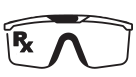
The “-2” tells you the eyewear is made for prescription lenses. You’ll usually see Z87-2 (or Z87-2+ for high impact) stamped on the frame, often inside the temple arm or bridge, since the prescription lenses themselves often aren’t marked. No mark, not certified.
Do scratched safety glasses still protect my eyes?
Less than they should. A deep scratch can become a weak point on impact, and it blurs your vision, which is its own hazard. Once a lens is badly scratched, pitted, or cracked, replace it.
Can I use regular eyeglass cleaner on safety lenses?
Check the label first. Some household and glass cleaners contain solvents that strip anti-fog and anti-scratch coatings. Safest is mild soap and water, or a lens spray made for coated lenses, dried with a microfiber cloth, not a paper towel or your shirt.
Do safety glasses protect against lasers?
No. Standard ANSI Z87.1 safety glasses are not laser protection. Laser work requires eyewear with the correct optical-density rating for that specific wavelength, which is a different product entirely.
Ready to pick a pair?
Browse ANSI-rated safety glasses. If you wear a prescription, read the complete guide to ANSI prescription safety glasses and shop prescription eyeglasses verified in our U.S. optical lab.