




























































Manufacturing · ANSI Z87.1 Guide
Manufacturing Safety Glasses: ANSI Z87.1 Eye Protection for the Plant Floor
Flying chips, coolant mist, grinding sparks, and chemical splash are part of the shift. Here is what OSHA 1910.133 and the ANSI Z87.1 standard require, and what actually holds up on a production line.
Shop ANSI-rated safety glasses →Manufacturing is the single largest source of occupational eye injuries in the United States. In the most detailed federal breakdown, the Bureau of Labor Statistics counted more than 27,000 eye injuries serious enough to cost a worker days away from work in a year, and manufacturing accounted for about a quarter of them, more than any other industry. Flying metal chips and particles were the single most common cause. OSHA 1910.133, the general-industry rule, requires eye and face protection whenever workers face flying particles, molten metal, liquid chemicals, or injurious light, and that protection has to meet ANSI Z87.1. This guide covers the hazards a plant actually presents, what the standard asks for, and how to choose by operation, without overspending.
The eye hazards on a manufacturing floor
Manufacturing is not one hazard, it is several, and they change by department. Most eye injuries on a plant floor trace back to these:
- Flying chips, swarf, and turnings — high-velocity, often hot metal thrown by turning, milling, drilling, and sawing. This is the dominant cause of manufacturing eye injuries.
- Grinding grit and wheel failure — a steady stream of abrasive particles and sparks, plus the rare but serious risk of a bursting wheel.
- Metalworking fluid mist — coolant and cutting-fluid aerosol that irritates the eyes, an exposure most generic guides ignore.
- Chemical splash and vapor — degreasers, solvents, parts-cleaning chemicals, and plating acids.
- Molten metal and radiant heat — foundry, forging, casting, and heat-treat work, where splash and infrared both reach the eye.
- Compressed-air blowback — using air to clean chips off parts launches particles back at the operator and bystanders.
- Laser radiation — fiber and CO2 cutting, marking, and welding cells, where ordinary safety glasses offer no protection at all.
The hazard plants underestimate: coolant mist
Metalworking fluids, the coolants and cutting fluids that flood a machining operation, throw a fine aerosol that OSHA lists as a cause of eye, nose, and throat irritation, and they splash when handled as concentrate. Open safety glasses do little against a mist or a side splash. The right answer is layered: mist-collection and splash guards on the machine first, with indirect-vent goggles for workers in the mist or handling fluid. See OSHA’s guidance on metalworking fluid health effects.
What OSHA 1910.133 and ANSI Z87.1 require
A plant or machine shop runs under OSHA’s general-industry rule, 29 CFR 1910.133, not the construction standard. The rule is specific: any worker exposed to flying particles, molten metal, liquid chemicals, caustic liquids, chemical gases or vapors, or injurious light radiation must wear eye protection that meets ANSI Z87.1. For most manufacturing tasks, that means the higher-impact Z87+, because flying chips and grinding debris look more like the high-velocity test than the basic ball-drop. A few practical points:
- Z87+ over plain Z87 — the high-velocity and high-mass rating matches the projectile risk on a machining or press line.
- Side protection — a wraparound frame or side shields wherever there is a flying-object hazard.
- The marks live on the gear — Z87 or Z87+ on the lens and the frame, plus D-marks for splash and dust (D3, D4, D5), a W shade number for welding and radiant heat, and an X for anti-fog. Match them to the hazards you actually face.
- A hazard assessment comes first — OSHA requires a written assessment of the workplace before assigning PPE (29 CFR 1910.132(d)).
On the edition question: OSHA’s general-industry rule incorporates the 2010, 2003, and 1989 editions of Z87.1 by reference. Eyewear built to the current ANSI/ISEA Z87.1 edition still complies under OSHA’s “at least as effective” provision, and the newer editions are written to meet or exceed the older ones. In practice, a properly marked Z87+ pair from a reputable maker satisfies the rule.
The quick rule
If the operation throws, sprays, or melts anything, machining, grinding, pressing, or hot work, start at Z87+. Plain Z87 is basic-impact only. The frame and the lens both have to carry the mark; a tough lens in an unrated frame is not compliant.
Recommended protection by operation
The right frame depends on the operation, not on the word “manufacturing.” Match the gear to the work in front of you.
CNC machining, milling, turning
Z87+ wraparound or sealed-side glasses for high-velocity chips and coolant; foam-gasket frames where mist and fine particles are heavy.
Grinding and cutoff work
Z87+ goggles, or Z87+ glasses with a face shield over them for prolonged grinding. The shield is secondary, never the only protection.
Press, stamping, forging
Heavier high-impact frames built for large-debris risk; skip lightweight frames where impact margin matters.
Welding and welding-adjacent
A welding helmet or filter in the correct shade over a Z87+ base for welders; Z87+ for nearby fitters and fire-watch. See welding safety glasses.
Degreasing, solvents, plating
Indirect-vent chemical-splash goggles (look for D3), with a face shield over them for high-energy splash like charging a tank.
Outdoor yards and lift trucks
Tinted Z87+ lenses with UV protection for daylight glare; see ANSI-rated safety sunglasses.
Three hazards generic guides miss
Most “wear your safety glasses” advice stops at impact. On a real plant floor, three exposures cause trouble precisely because they are under-discussed.
Coolant and metalworking-fluid mist
Covered in the callout above: the aerosol irritates the eyes and the concentrate splashes. Engineering controls (mist collection, enclosures) come first, with indirect-vent goggles for workers in the mist. Open glasses are not the answer for an aerosol.
Blowing chips off with compressed air
It is everywhere in machine shops, and OSHA limits it for good reason. Compressed air used for cleaning has to be reduced to under 30 psi at the nozzle and used with effective chip guarding and personal protective equipment (29 CFR 1910.242(b)). Air-blown chips ricochet around open glasses, so this is a sealed-goggle task, and bystanders need protection too.
Laser cutting, marking, and welding cells
This one is critical: Z87+ safety glasses do not protect against laser radiation. Laser eye protection is specific to the machine’s wavelength and is rated by optical density; a fiber laser and a CO2 laser need different filters, governed by ANSI Z136. Enclosed cells rely on interlocks and guarding as the primary defense, with rated eyewear for maintenance and alignment access. Never treat ordinary safety glasses as laser protection.
Lens and coating choices that earn their keep
Past the impact rating, a few choices decide whether workers keep the eyewear on all shift:
- Anti-fog (the X mark) — treat this as a compliance spec, not a luxury. Fogging is the top reason workers push eyewear up onto their forehead; an anti-fog lens keeps it on. Shop anti-fog safety glasses.
- Anti-scratch hardcoat — a hardened surface that survives chip contact, coolant spray, and frequent cleaning; it buys real lens life on a line.
- Clear indoors, tinted outdoors — indoor production under plant lighting calls for clear lenses; tints belong in outdoor yards and docks, not on the floor where they cut visibility.
- Shaded or IR-filter lenses for hot work — foundry, forging, and heat-treat work need a shade rated for radiant energy, paired with a face shield, per the shade table in 1910.133.
Prescription safety glasses for machinists
Many machinists and plant workers wear prescription glasses, and the cheapest path to compliance, safety eyewear worn over everyday glasses, is also the one that fails most often on a line. Over-glasses trap a fog gap that condenses by mid-shift, put side pressure on the inner frame so it slides down the nose, and double the mass on the face under a hard hat and ear muffs. All three predict the same thing: the worker takes the eyewear off.
OSHA lets you meet the requirement two ways: prescription lenses built into a rated frame (marked Z87-2 or Z87-2+), or compliant over-the-glasses protectors worn over your everyday glasses without disturbing their fit (29 CFR 1910.133(a)(3)). For all-shift wear, built-in prescription lenses are usually the better call: one frame, one fit, one cleaning step. At SafetyGearPro, your prescription is cut in our U.S. optical lab and checked by our team before production, with high-index lenses for stronger prescriptions to keep them light. Prescription safety glasses are FSA/HSA eligible, ship free over $99, and typically take about 10 business days to make. Start with ANSI prescription safety glasses, or browse the full prescription safety eyeglasses range. Where eye protection is required, employers generally pay for it, though OSHA lets them treat non-specialty prescription safety glasses you can take home as an exception (29 CFR 1910.132(h)).
Working with the rest of your PPE
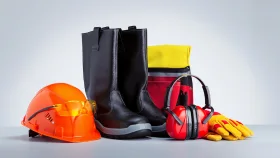
On a plant floor, eye protection shares your head with hearing protection, sometimes a respirator, and in many areas a hard hat. A few things to get right so all of it keeps working:
- Hearing protection — thick temple arms break the seal of an ear muff and cut its noise reduction; slim or wire-core temples sit better under muffs.
- Respirators — if your glasses fog with a mask on, the respirator is not sealed, so reseat it. On a tight-fitting respirator, eyeglass temples cannot cross the face seal; full-face respirators take a prescription insert that mounts the lenses inside the mask.
- Face shields — a face shield is secondary protection, worn over safety glasses or goggles for grinding, splash, or hot work, never instead of them.
- Hard hats — where they are required, confirm the frame clears the suspension without pressure points, especially when stacked with muffs.
Inspection and replacement
Inspect lenses for cracks, pitting, and deep scratches, and replace them the moment any of those appear; a damaged lens both blurs vision and gives way at the point of impact, and it no longer meets the standard. There is no single replacement schedule, but service life tracks the operation: high-intensity work like CNC, grinding, press, and forging wears lenses fast through chip impact, coolant spray, and frequent cleaning, while inspection and supervisory roles get much longer life. A plant program is easier to budget and audit when replacement is tracked on a set cadence rather than handled ad hoc.
Related guides & where to shop
- The standard: ANSI-Rated Safety Glasses (the standard explained) — how Z87.1 markings, impact levels and lens tints actually work.
- Related job: Automotive safety eyewear — brake dust, battery acid and grinding sparks.
- Related job: Welding safety eyewear — filter shades and Rx under the helmet.
Ready to gear up? Shop prescription safety glasses · anti-fog safety glasses · safety glasses.
Frequently asked questions
What eye protection does OSHA require for manufacturing?
Manufacturing falls under OSHA 29 CFR 1910.133, the general-industry eye and face protection rule, which requires protection meeting ANSI Z87.1 wherever workers face flying particles, molten metal, liquid chemicals, or injurious light. Most operations call for Z87+ specifically, the high-velocity rating, because flying chips and grinding debris behave more like the high-velocity test than the basic ball-drop.
Is manufacturing really the biggest source of workplace eye injuries?
Yes. In the most detailed BLS breakdown of eye injuries that cost workers days away from work, manufacturing was the single largest industry division, about a quarter of all cases, ahead of construction and trade. Flying metal chips and particles were the most common single cause. Claims that manufacturing accounts for “half” of eye injuries are not supported by that data.
Do different manufacturing operations need different eye protection?
Yes. CNC machining and turning face high-velocity chips and coolant, calling for Z87+ wraparound or sealed frames. Grinding adds abrasive grit, which favors goggles or a face shield over glasses. Press and forging face large-debris impact. Degreasing and plating face chemical splash, which needs indirect-vent goggles. Match the gear to the operation rather than treating “manufacturing” as one hazard.
Does coolant or metalworking-fluid mist affect the eyes?
Yes. OSHA lists eye, nose, and throat irritation among the health effects of metalworking fluids, and the concentrate can splash when handled. The right approach is layered: mist collection and splash guards on the machine first, with indirect-vent goggles for workers in the mist or handling fluid. Open safety glasses do little against an aerosol or a side splash.
Can I use compressed air to blow chips off parts?
Only under limits. OSHA requires compressed air used for cleaning to be reduced to under 30 psi at the nozzle and used with effective chip guarding and personal protective equipment (29 CFR 1910.242(b)). Air-blown chips ricochet around open glasses, so this is a sealed-goggle task, and nearby workers need protection too.
Do Z87+ safety glasses protect against laser cutting or marking?
No. Z87+ safety glasses do not protect against laser radiation. Laser eye protection is specific to the machine’s wavelength and rated by optical density, governed by ANSI Z136; a fiber laser and a CO2 laser need different filters. Enclosed laser cells rely on interlocks and guarding as the primary defense, with rated eyewear for maintenance and alignment access.
Are tinted safety glasses appropriate for indoor manufacturing?
Generally no. Indoor production under plant lighting does not justify tinted lenses, and tints reduce visibility in lower-lit areas of the facility. Clear lenses, optionally with anti-reflective coating, are the right pick indoors. Tints belong in outdoor yards, docks, and outdoor lift-truck work, where smoke-grey ANSI-rated lenses cut daylight glare.
How often should manufacturing eye protection be replaced?
Replace immediately for any crack, pitting, or scratch that affects clarity, since a damaged lens is no longer ANSI-rated. There is no fixed schedule otherwise, but service life tracks the operation: CNC, grinding, press, and forging wear lenses fast through chip impact and coolant spray, while inspection and supervisory roles get longer life. Tracking replacement on a set cadence is easier to budget and audit than ad-hoc swaps.
Can machinists wear their regular prescription glasses on the floor?
No. Standard prescription eyewear is not impact-rated. A machinist needs prescription safety lenses marked Z87-2 or Z87-2+, or compliant over-the-glasses protectors worn over everyday glasses without disturbing their fit. For all-shift wear, built-in prescription safety glasses are usually the better solution.
Why are dedicated prescription safety glasses better than over-glasses on a line?
Over-glasses worn on top of everyday frames fail three ways in real plant conditions: they trap a fog gap that condenses by mid-shift, they put side pressure on the inner frame so it slides down the nose, and they double the mass on the face under a hard hat and ear muffs. Each predicts mid-shift removal. Built-in prescription lenses cut the script into one impact-rated frame: one fit, one cleaning step, better seal.
How does eye protection work with hearing protection and respirators?
Thick temple arms break an ear muff’s seal and cut its noise reduction, so slim or wire-core temples are better under muffs. On a tight-fitting respirator, eyeglass temples cannot cross the face seal; full-face respirators use a prescription insert that holds the lenses inside the mask. Anti-fog lenses matter here, since a fogging lens under a mask is both a productivity and a compliance problem.
Does my employer have to pay for prescription safety glasses?
For required PPE, generally yes. OSHA makes the employer provide and pay for eye protection wherever there is a hazard. The main exception is non-specialty prescription safety glasses the worker is allowed to take off-site (29 CFR 1910.132(h)); specialty items like laser-filter prescription lenses fall back under employer-pay.
Are bulk orders and GSA documentation available for plants?
Yes. We provide compliance documentation, bulk pricing, and GSA-friendly purchasing for manufacturing facilities and government work through our corporate safety eyewear program.
For plant safety managers
Outfitting a plant is a program, not a one-off purchase. OSHA requires a written hazard assessment before assigning PPE (29 CFR 1910.132(d)), and the non-mandatory Subpart I Appendix B gives a usable selection worksheet. The highest-leverage moves we see: designate the production floor a 100 percent eye-protection zone, treat anti-fog as a compliance spec so workers keep the gear on, run a prescription safety-eyewear program for the workforce, and build a replacement cadence into the budget. For volume or government work, we handle bulk pricing, compliance documentation, and GSA purchasing through our corporate safety program.
Ready to equip your plant?
Browse ANSI Z87.1 compliant safety glasses, goggles, and prescription options, with bulk pricing and OSHA documentation available.