



























































Construction Safety Glasses: ANSI Z87.1 Eye Protection for Jobsites
Flying debris, concrete dust, UV glare, and chemical splash are daily on a jobsite. Here is what OSHA 1926.102 and the ANSI Z87.1 standard require, plus what actually holds up on site.
Shop ANSI-rated safety glasses →We have supplied PPE to construction crews since 2010, and the same preventable injuries keep repeating: a concrete chip or a piece of rebar that ends a shift, or a career. Per BLS and CPWR figures, construction accounts for roughly a fifth of all U.S. workplace eye injuries, more than 10,000 a year, and in most of those cases the worker was not wearing eye protection. OSHA 1926.102 requires eye and face protection whenever workers face flying particles, molten metal, liquid chemicals, or harmful light, and that protection has to meet ANSI Z87.1. The rule still names earlier editions of the standard by reference, but the current edition is ANSI/ISEA Z87.1-2025, and equipment that meets it satisfies the requirement. This guide covers the hazards, what the standard asks for, and what holds up in the field, without overspending.
The 5 most common eye hazards on a construction site
Most jobsite eye injuries trace back to one of five hazards. Knowing which ones you face decides the rating and style you need.
- Flying particles and debris — dust, concrete, wood, and metal shavings from grinding, sawing, and sandblasting.
- Projectiles (penetration) — nails, staples, and metal shards from power tools and nail guns. Nail guns alone send an estimated 37,000 people to the ER a year, and contact-trigger models carry about twice the injury risk of sequential-trigger ones.
- Chemical splash and burns — solvents, adhesives, and wet cement.
- Optical radiation — UV from the sun, or “welder’s flash” from arc welding and cutting.
- Blunt-force impact — falling objects or collisions with equipment.
Wet concrete and cement are caustic. Adding water to Portland cement forms calcium hydroxide and pushes the pH above 12, and alkaline burns penetrate the eye fast, deeper than an acid splash. Treat wet slurry in the eye as an emergency: flush with clean water and get medical help. When you are placing, mixing, or cutting concrete, sealed or indirect-vent goggles, not open glasses, are the right call.
What ANSI/ISEA Z87.1-2025 means for construction crews
The 2025 revision tightened the markings, impact testing, lens haze, and minimum coverage. For most jobsites, that translates to four things:
- Z87+ for high-velocity and high-mass impact, not just basic Z87.
- Side protection from a wraparound frame or detachable side shields.
- Anti-fog and anti-scratch coatings so they stay clear and usable all shift.
- A proper fit with padded temples, so they do not slip when you look down or sweat.
Beyond the Z87+ impact mark, a lens can also carry D-marks for splash and dust (D3, D4, D5), a U-scale number for UV, and an X for anti-fog. Match them to the hazards you actually face.
On the edition question: OSHA’s construction rule incorporates the 2010, 2003, and 1989 editions of Z87.1 by reference, not the 2025 edition. Eyewear built to a newer edition still complies under OSHA’s “at least as effective” provision, and the newer editions are written to meet or exceed the older ones. In practice, a properly marked Z87+ pair from a reputable maker satisfies the rule.
If the task throws anything, grinding, cutting, nailing, or demolition, you want Z87+. Plain Z87 is basic-impact only. The frame and the lens both have to carry the mark; a tough lens in an unrated frame is not compliant.
Recommended protection by task
Match the eyewear to the work in front of you.
Concrete dust and silica
Cutting, grinding, or drilling concrete, masonry, and brick throws respirable crystalline silica, the dust behind OSHA’s silica standard for construction (29 CFR 1926.1153). That dust is also an eye irritant, and the fine particles slip around open safety glasses. On dusty concrete work, a sealed or foam-gasket frame or a dust goggle (look for the D4 or D5 dust marking) keeps it out. Eye protection here is a complement to the silica rule’s dust controls, water and vacuum capture, not a substitute for them.
Coatings that earn their keep on a jobsite
Three coatings make the difference between glasses crews wear and glasses they push up onto a hard hat:
- Anti-fog — the one most crews wish they had, for temperature swings, sweat, and respirator use. Look for the X mark on lenses that passed the anti-fog test, or shop our anti-fog safety glasses.
- Anti-scratch (hardcoat) — a hardened surface that holds up to dust and grit; it does not make a lens scratch-proof, but it buys real life on site.
- UV tint — for outdoor crews, a tinted lens with UV protection (the U-scale mark) that still meets Z87+.
- Polarized or mirrored — cut glare off concrete, water, and glass for outdoor work. One caveat: polarized lenses can wash out LCD screens, so operators reading equipment displays or total stations may prefer a plain tint.
Prescription safety glasses for construction
OSHA lets you meet the requirement two ways: prescription lenses built into a rated frame (marked Z87-2 or Z87-2+), or compliant over-the-glasses (OTG) protectors worn over your everyday glasses. For an all-shift fit, built-in prescription lenses are usually the better call. At SafetyGearPro, your prescription is cut in our U.S. optical lab and checked by our team before production, with high-index lenses for stronger prescriptions to keep them light. Prescription safety glasses are FSA/HSA eligible, ship free over $99, and typically take about 10 business days to make. Start with ANSI prescription safety glasses, or browse the full prescription safety eyeglasses range. If your employer requires eye protection, they generally pay for it, although OSHA lets them treat non-specialty prescription safety glasses you can take home as an exception (29 CFR 1926.95).
Working with the rest of your PPE
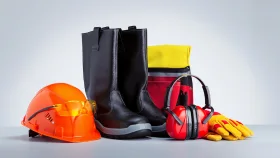
On a jobsite, eye protection shares your head with a hard hat, ear protection, and sometimes a respirator. A few things to get right so all of it keeps working:
- Hard hats — thick temple arms can lift ear-muff cushions and cut their noise reduction; slim or wire-core temples sit better under a hard hat and muffs.
- Respirators — if your glasses fog with a mask on, the respirator is not sealed, so reseat it and pinch the nosepiece. On a tight-fitting respirator, eyeglass temple arms cannot cross the face seal; full-face respirators take a prescription insert that mounts the lenses inside the mask.
- Face shields — a face shield is secondary protection, worn over your safety glasses or goggles for grinding, cutting, or heavy splash, never instead of them.
Daily inspection and care
Inspect every shift for cracks, pitting, or loose side shields. Clean with mild soap and water and dry with a microfiber cloth; dry-wiping a dusty lens drags grit across it and scratches it. Replace a lens the moment it is cracked, pitted, or badly scratched; a deep scratch does not just blur vision, it weakens the lens at the point of impact, and a damaged pair no longer meets the standard. There is no fixed replacement schedule, but heavy dust and grinding scratch lenses quickly, so expect to swap them often.
Related guides & where to shop
- The standard: ANSI-Rated Safety Glasses (the standard explained) — how Z87.1 markings, impact levels and lens tints actually work.
- Related job: Mining safety eyewear — MSHA, underground fog and surface glare.
- Related job: Agriculture safety eyewear — UV, dust/chaff and EPA pesticide rules.
- Related job: Electrical safety eyewear — non-conductive frames and NFPA 70E arc flash.
Ready to gear up? Shop prescription safety glasses · ANSI-rated industrial safety sunglasses · safety glasses.
Frequently asked questions
Is ANSI/ISEA Z87.1 mandatory for construction?
OSHA 1926.102 requires eye and face protection that meets ANSI Z87.1. The rule still names earlier editions by reference (Z87.1-2010 and prior), but the 2025 edition is the current consensus version, and equipment that meets it satisfies the requirement. Look for the Z87 or Z87+ mark.
What’s the difference between Z87 and Z87+ markings?
Z87 means basic-impact protection. Z87+ (or Z87-2+ for prescription) passes the tougher high-velocity and high-mass impact tests, which is what you want for most construction tasks: grinding, cutting, nailing, and demolition.
Can regular prescription glasses be used on a construction site?
No. Standard prescription eyewear is not impact-rated. You need prescription safety lenses marked Z87-2 or Z87-2+, or compliant over-the-glasses (OTG) protectors worn over them.
Do prescription safety glasses need special markings?
Yes. The lenses carry Z87-2 (basic) or Z87-2+ (high impact), and the frame has to be marked too. The current Z87.1 edition spells out the prescription-lens requirements clearly.
Do I need goggles or just safety glasses for concrete cutting and grinding?
For high-dust, high-velocity work like concrete cutting or grinding, sealed or indirect-vent goggles (Z87+) protect better than open glasses. Many crews pair Z87+ wraparound glasses with a face shield for extra coverage.
How do I prevent fogging on safety glasses during long outdoor shifts?
Choose lenses with a good anti-fog coating. On humid or cold days, indirect-vent goggles handle it best. An anti-fog spray helps between cleanings; skip dry-wiping, since it scratches the lens.
Are tinted safety glasses allowed outdoors on construction sites?
Yes, as long as they provide UV protection and still meet Z87+ impact requirements. Confirm against your site hazard assessment.
Can I wear safety glasses over my regular prescription glasses?
Only if the over-the-glasses (OTG) protectors are ANSI Z87+ rated and keep proper fit and coverage. For all-shift comfort, built-in prescription safety glasses are usually the better solution.
How often should construction safety glasses be replaced?
Inspect every shift for cracks, pitting, scratches, or loose side shields, and replace immediately if damaged. Even with good care, replace at least once a year, sooner in heavy dust, chemical, or high-use environments.
Do we need face shields in addition to safety glasses?
Yes, when the hazard assessment shows a risk of large flying objects, molten metal, or heavy chemical splash. A face shield goes over your primary Z87+ eye protection, not instead of it.
Are bulk orders and GSA documentation available for construction crews?
Yes. We provide compliance documentation, bulk pricing, and GSA-friendly processes for federal, state, and large commercial construction projects.
Does my employer have to pay for my safety glasses?
For required PPE, generally yes. OSHA makes the employer provide and pay for eye protection wherever there is a hazard (29 CFR 1926.95). The main exception is non-specialty prescription safety glasses you are allowed to take off-site; specialty prescription eyewear is not exempt.
Is wet cement or concrete dangerous to the eyes?
Yes. Wet cement is caustic, with a pH above 12, and an alkaline splash can burn the cornea quickly, deeper than an acid splash. Flush with clean water and get medical help right away. Sealed goggles are the right protection when you place, mix, or cut concrete.
Do safety glasses work with a hard hat and respirator?
They can, with the right pieces. Slim temples sit better under a hard hat and ear muffs. On a tight-fitting respirator the temple arms cannot cross the face seal, so full-face respirators use a prescription insert that holds the lenses inside the mask. If your glasses fog under a mask, the respirator is not sealed.
For safety managers and crews
Outfitting a crew is a program, not a one-off purchase. OSHA requires a written hazard assessment before assigning PPE (29 CFR 1910.132) and training on how to wear and care for it. NIOSH and CPWR publish free construction toolbox talks, including one on eye protection, that work for a five-minute jobsite briefing. For volume or government work, we handle bulk pricing, compliance documentation, and GSA purchasing through our corporate safety program.
Ready to equip your crew?
Browse ANSI Z87.1 compliant safety glasses, goggles, and prescription options, with bulk pricing and OSHA documentation available.